Praying Mentis

A Laymen's Journey into the Catholic faith.
Showing posts with label God. Show all posts

Monday, October 22, 2012

On a Wise Choice

I have to admit, I never thought much of Casting Crowns. It was one of my Dad's favorite bands. I remember him calling me upstairs to listen to them on several occasions. I was listening to Pandora today, and the song, "If We Ever Needed You,"  came on. I was reading the Catechism at the time, about our call to be Christian and how the apostles first started their mission (see Mark 16:20).


It made me remember a conversation I had with a good friend back my senior year of college. My friend asked what the difference was between living a Christian life and not. My answer should've been, "When there is a christian preaching the gospel of God, you will know God is there because of the signs that will necessarily follow." I knew this then, but I didn't know how to articulate it. When you are doing what God asks you to, you can better see him around you in the small things. Especially in subtle coincidences and in answered prayers.

One reason we fall from God is because we have some kind of doubt that we feel needs to be settled. Or we have a sin that we can't let go of which can cause us to lose faith (because we justify our sin to ourselves). Doubt can arise from simply not looking toward God. I think everytime I am weak in my faith it is for that reason. I try to do things on my own. But if we search for God, we will find Him. Despite the simple nature of the previous statement, this search can be difficult. I was reading St. Augustine today and the intensity of his search for God through prayer struck me:


"...tell me of Thy compassion, O Lord my God, what Thou art to me. 'Say unto my soul, I am thy salvation.' So speak that I may hear. Behold, Lord, the ears of my heart are before Thee; open Thou them, and “say unto my soul, I am thy salvation.” (Confessions of St. Augustine)


I know I keep bringing up my Dad, but I feel it is relevant to this subject. The last thing my dad said to me before his first heart failure was, "David, do you look back in your life and find how God has worked in your life these past few years?" I smiled and turned back to him thinking he was being his overly contemplative self, and said " Yes! Are you kidding?" And I cited the reasons. There are too many to mention right now, but i will say meeting my fiance is one of them. 

I'm reminded of what Pope Benedict had to say on starting actions with prayer: "Whenever we pray together, where we receive God’s gifts with thankfulness, a new heart comes into being, which also changes us ourselves..." (God is Near Us: The Eucharist, the Heart of Life. Page 52). It is important for us to always remember God's gifts in order for us to be changed, and to have a "new heart".


Too often we forget God's gifts in our lives and become ungrateful. We become exactly like the Israelites fleeing from the persecution of the Pharaoh, who after being persecuted all of their lives by a ruling dictator (Satan), displace their anger upon the God who liberated them. They began to seek other means to overcome the pain they were experiencing, which involved seeking idles over God. They didn't realize that God Himself was there for them, and time and time again God revealed Himself to them. And yet, they required more to believe, as is the case with us. 

We don't realize that our sins have punishments despite the fact that they are forgiven. Or in terms of the graph below we become ungrateful as the gifts we are given pile up. But maybe the greatest punishment we receive is the consequential punishment of unrequited love. 

"What am I to Thee that Thou demandest my love, and unless I give it Thee art angry, and threatenest me with great sorrows? " (Confessions of St. Augustine)


Not to distort the order of things too much, but the above quote was what inspired this blog in the first place. This one quote reminds me of the brokenness I have seen around me. Everywhere I see brokenness I also see rejection of God. God is love, so those who reject Him are essentially casting themselves into sorrow. It's kind of sad really. Or in other cases, God comes secondarily to some other material object. That in mind, let me share with you this quote:


"We did what was right in our eyes, and now our children will pay the price." (Casting Crown, If We Ever Needed You)


Sin never only affects us. If you choose not to spread God's message to world, you're choosing to spread the message of another "god". Or as John Lenin put it, 


"You're gonna have to serve somebody/Well, it may be the devil or it may be the Lord/But you're gonna have to serve somebody."


Our sin directly affects everyone around us as well as God, which is a fact we often overlook. Our family, friends, and especially our future or present children. This is something that has helped me to put the proper weight to the seriousness of sin in life, and has helped me to continually battle against it.


Augustine of Hippo. (1886). The Confessions of St. Augustin J. G. Pilkington, Trans.). In P. Schaff (Ed.), A Select Library of the Nicene and Post-Nicene Fathers of the Christian Church, First Series, Volume I: The Confessions and Letters of St. Augustin with a Sketch of His Life and Work (P. Schaff, Ed.) (46). Buffalo, NY: Christian Literature Company.

Tuesday, August 28, 2012

Hope in Death Part 3

On the Feast of the Assumption of Mary, the visiting priest at my parish asked me to think of ways that Mary had intervened during the past few years in my life. I came to the powerful realization that Mary has helped me very recently. I should, now that I think more about it, thank that priest for personally helping me to see Mary.


There is an unwritten and for some reason mostly unspoken rule of thumb in the spiritual world. If you pray with someone you will be closer to them. It's a very brief and to-the-point rule. Every time you go to God who is entirely Love, you pull down a piece of Him with you.

I would like to share one last piece of my Dad's death with you. When I got the call I raced down south from Northern Washington State. All I knew was my Dad was dying. It was serious. All I could think to myself was, God please let my Dad live long enough to receive last rites from a priest and for me to visit him one last time. 


Long story short I made it to the hospital. And waited for hours. Let me tell you this, there are two ways this story could have ended.


1.) No one prayed. We all sat and let our minds wander about how much we hoped our Dad didn't die. And then we would talk about video games, jobs, typical day stuff.  (This situation almost happened.)


2.) The opposite. Would the first option really be worthy to be called a "beautiful of death?"


Here is what happened. My family began talking about normal things. Then Lizzie, my fiance, helped me to start a rosary with my family. I could barely say the words. "...Holy Mary pray for us sinners now and at the hour of our death. Amen." I thought to myself: 'How many times have I said those words with no meaning, only now to hope so much in them?'


=
My Brother Sam then lead us in a Divine Mercy Chaplet. My family never prayed together, and now they were being led by my youngest brother, the shiest person I know, in a sung version of the Divine Mercy Chaplet. Before we started I told my Brother, "Hey, Sam, keep it on the down low ok? Remember we're in a hospital." Then I realized as I was starting that there was no reason for him to keep quiet. And so Sam sang the Divine Mercy Chaplet with his beautiful voice which he attests is now officially better than Josh Groban's. (I believe him too... I mean if I could go to one mass with him and have someone not compliment his voice)

Anyways, I digress. I have told many people how Matthew, a firefighter-in-training friend, was at my brothers' house when my Dad had his initial heart failure. He performed CPR on my dad, which helped him live a little longer, just enough for everyone to see him again. I wanted to let those who thought to themselves, ok... so... your Dad lived just to die. That's no miracle--- know that it was.


The Catechism of the Catholic Church states:


1014 


The Church encourages us to prepare ourselves for the hour of our death. In the ancient litany of the saints, for instance, she has us pray: "From a sudden and unforeseen death, deliver us, O Lord";588 to ask the Mother of God to intercede for us "at the hour of our death" in the Hail Mary; and to entrust ourselves to St. Joseph, the patron of a happy death.


The small things really help put things into perspective. We prayed to Mary and Matthew a trained firefighter just so happened to be spending the weekend at my brothers. This allowed my Dad to not have an unforeseen death. I would say it was the most beautiful death anyone could ask for in fact. If I could have Sam sing a divine mercy chaplet on my death bed, and know that my family was brought together in prayer from the process I would die a happy man.


Friday, August 24, 2012

Hope in Death part 2


While 'death' is an interesting topic in itself which I plan to write more about, the main reason I write this post is because early in the morning on June 14th, my Father died at the age of 63. Everything I believed in was shaken. (Please, do not offer condolences) To be honest, I was mad at God. Even though I don't care to admit it, I blamed God often in the months following my dad's death, and wasn't able to crush that anger until recently. I felt as though I had become a different person, someone who was hopeless and despondent. Several questions plagued my mind:

Why would a perfectly just, loving merciful God take someone away before they can say good-bye? Why would a perfectly just God let someone suffer so much and not act? Why would a perfectly loving God give no assurance that your loved one is alive and well in the afterlife, knowing full well the grief it causes?

And why would a loving God kill my dad when I was getting married in less than a year, and my brother was going to have his baby a month later?

I am writing this because I want to help those who go through these same emotions, the same emotions I experienced. Although these answers may not be the same for everyone, these are the things I experienced after the death of my dad:

You can call me crazy, but nearly all of my siblings had dreams of my Father saying goodbye and that he was well even though he wished he could stay. Almost identical every time. You can think whatever you want, but it happened... and strangely enough a barber I talked with two months before my Dad died had shared with me that the same thing happened to his family.

Not only that, but the night my Dad suffered a second heart attack he said he saw people in white in the room with him. He was almost sure they were angels so he started trying to ask what the people were doing to methodically figure out which ones were there and which weren't. Most people in hospitals wear scrubs, not white. Anyways, he said he saw the room begin to disappear like the matrix and it was Godlike.

So why does God let people suffer? I think the answer might be that evil exists and is real, partially because we let it exist. We actively participate in the spreading of evil by not spreading good. It was man that started the progression of sin.

I've met some genuinely amazing people throughout my life, and they've all taught me something very similar. We are meant for much more than we give ourselves credit. We are not meant to sit ideally by as the world turns to sin; we are supposed to act! Preaching fully convinced that the word of God is real-- that Jesus is behind our backs and in our hearts.

As to why God takes people at times that make it difficult to accept, I think the answer to that question is simply that there is a time and place for every thing in this world. We may not understand it now, it may be uncormfortable but as a wise theologian says, (I honestly don't remember who said this) God does not want what is comfortable for us, he wants for us to be holy, like He Himself is holy. Every moment is an opportunity for good or evil, and God puts us in the circumstances where we can do the best. In the end we will all die, and that day, we will be transformed.

"There is an appointed time for everything, and a time for every affair under the heavens. A time to give birth, and a time to die; a time to plant, and a time to uproot the plant. A time to kill, and a time to heal; a time to tear down, and a time to build. A time to weep, and a time to laugh; a time to mourn, and a time to dance... God has made everything appropriate to its time, but has put the timeless into their hearts so they cannot find out, from beginning to end, the work which God has done. I recognized that there is nothing better than to rejoice and to do well during life." 
(Ecclesiastes 3:1-4, 11-12)

Friday, August 17, 2012

On Hope in Death Part 1

I was not originally going to make this post. Why? Because, who in their right mind writes about death, especially when it is such a sensitive topic to everyone? But then again, why wouldn't a Catholic write about death? I've read countless other blogs that proclaim the message "carpe diem", seize the day, live for the moment... But what does that really mean? And so, thus begins my first trilogy--on death!


My question is this: Why have fear in death when you can have hope in death instead? This would be like opting for the treasure chest by itself instead of the treasure inside of it. You can truly live when you hope in death.


Society's view of death is a message of escape-- by living in the moment and never missing out on an "opportunity". There's this idea that there are constantly fleeting moments that you have to take advantage of by taking risks and embracing pleasure -- these magical moments that can be taken away from you. By death. But what do you actually lose when you die? When you're a Catholic the question becomes, 'What do I gain from death?'

The past few weeks I have been reading St. Paul, who writes about his hope in death:

"...We were utterly weighed down beyond our strength, so that we despaired even of life. 9 Indeed, we had accepted within ourselves the sentence of death, that we might trust not in ourselves but in God.  Why, we felt that we had received the sentence of death; but that was to make us rely not on ourselves but on God who raises the dead..." (2 Co 1:8–9)

St. Paul writes that death is not a bad thing, it is God's instrument of hope, and even trust. We have to trust in God's mercy when we die, and the promise of a life in heaven after we die can give us unimaginable hope when we actually embrace God's promise. Likewise, when our loved  ones die we have to hope they are in God's kingdom -- that they are happier than we had ever seen them during their lives on earth. 

St. Paul continues:"...Yet we are courageous, and we would rather leave the body and go home to the Lord. 9 Therefore, we aspire to please him, whether we are at home or away. 10 For we must all appear before the judgment seat of Christ, so that each one may receive recompense, according to what he did in the body, whether good or evil..." (2 Co 5:8–10). 

We cannot fear death as Catholics. God calls us throughout our lives to walk with him, and death actually puts us literally, by His side. Death brings us to our long awaited home and to our loving Father. This is what the Catholic Church has taught since its beginning during the time of the early Church fathers, and many of the saints write on the subject as well:

"...For God has called man and still calls him so that with his entire being he might be joined to Him in an endless sharing of a divine life beyond all corruption..." (Gaudium Et Spes)

St. Ignatius of Antioch writes in his letters while the Church is being persecuted: "For though I am alive while I write to you, I am eager to die." St. Dominic writes about how he will be more useful to others in death, "Do not weep, for I shall be more useful to you after my death and I shall help you then more effectively than during my life." Perhaps the reason for this is because often, we can do more in death than life. St. Teresa wrote,"I want to spend my heaven in doing good on earth."
Some, actually now that I think about it-- many considering how long I have talked about this, have called me fatalistic. I am not saying, go forth and die ye now because then ye will finally be with God. I am saying do not  fear death. If you do fear death, then fear death because it puts an end to your ability to love those around you by being physically present in the world. Even so, let me say this, this world is spiritual and physical. Scott Hahn said in his book, "Signs of life: 40 Catholic Customs and Their Biblical Roots" that our  salvation is very much so spiritual  and unseen. But the Catholic Church is the physical manifestation of that. I say this because I want all Catholic to believe that death is not the end for us. Eighty years out of  an eternity is still only eighty years. And although the spiritual reality of our salvation and those who have perished before us is hidden, it's still there. 

In conclusion, I don't have a problem with idea of living in the moment. I have a problem with this idea that we are constantly escaping a fleeting moment, and so we need to do as much as we can before we die with the hidden emphasis of to enrich our lives and those around us with positive memories. There is one question that we will ask ourselves on our death bed... It is not, did I live enough? Did I get to go wild in my youth? Did I get to see all the places I wanted to see? It is the same question God himself will ask us, "Did you love those around you the same way I have loved you?"  The question will be how much did you die to those around you. So I guess I would not have a beef with the motto,  "we should live for the moment" if there was a conjunction that said by dying and sacrificing for those around us. This is what we should be focusing on everyday, and everything else comes as a fruitful by product of living with that as your upmost priority. Love with all of your heart, give to the best of your ability as much as you can, die to yourself, because all other regrets will unquestionably be forgotten.  I will end with this quote by Saint Paul:


"But if Christ is preached as raised form the dead, how can some among you say there is no resurrection of the dead? If there is not resurrection of the dead, then neither has Christ been raised. And if Christ has not been raised, the empty too is our preaching; empty, to, your faith. Then we are also false witnesses to God, because we testified against God that he raised Christ, whom he did not raise if in fact the dead are not raised. For if the dead are not raised, neither has Christ been raised, and if Christ has not been raised, your faith is vain; you are still in your sings. Then those who have fallen asleep in Christ have perished. If for this life only we have hoped in Christ, we are the most pitiable people of all. But now Christ has been raised from the dead, the first fruits of those who have fallen asleep. For since death came through a human being, the resurrection of the dead came also through a human being. For just as in Adam all die, so too in Christ shall all be brought to life,but each one in proper order: Christ the first fruits; then, at his coming, those who belong to Christ; then comes the end, when he hands over the kingdom to his God and Father, when he has destroyed every sovereignty and every authority and power. For he must reign until he has put all his enemies under his feet.  The last enemy to be destroyed is death,  for “he subjected everything under his feet...” (1 Corinthians 12-27)


Friday, April 6, 2012

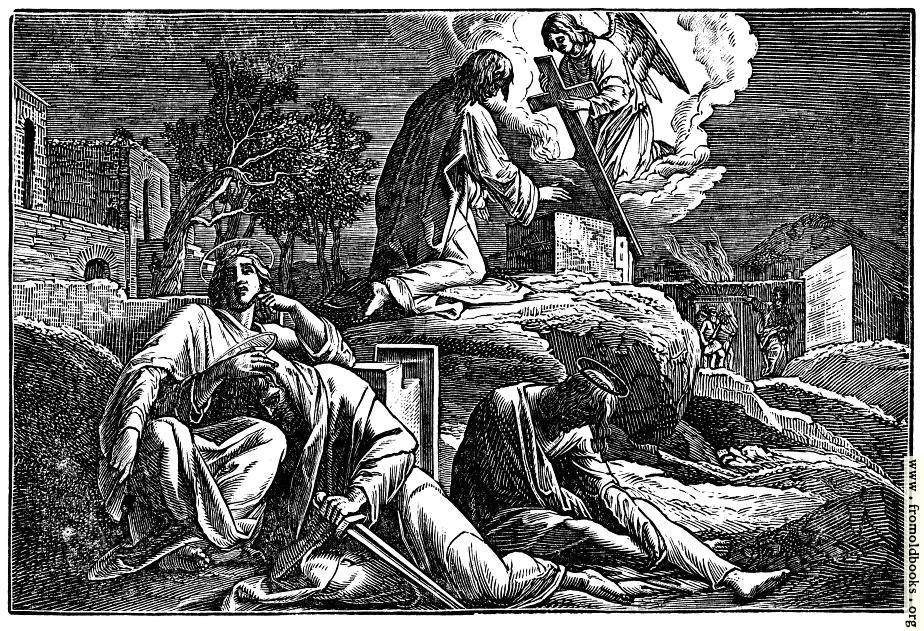
Garden Of Gethsemane

I have decided recently to post more theology blogs, I apologize, I meant to post this at the beginning of Lent... But... It took me awhile to edit it. Anyways, here is a fun analysis of the Garden of Gethsemane. 
---------------------------------------------------------------------------------

Word Study 

Gethsemane, literally translated into English means "suffering." This is what the garden was called far before Jesus went there, as if he knew and chose the location to say to us, "I know the suffering that is about to come, and I embrace it openly." Which, as we examine the passage on the Garden of Gethsemane more, we'll see that Jesus conveys this point in about 26 million different ways. The story would have been completely different if Jesus was not fully aware of what was going to happen next and would not have illustrated Jesus' love for us quite as powerfully.

An early church father Chrysostom comments on the Garden of Gethesamane, particularly on Matthew 26:36: "Then Jesus came with them to a place called Gethsemane, and said to His disciples, Sit here while I go over there and pray” (emphasis mine).
Chrysostom notes that Jesus' disciples were so adherent to Him and followed Him so intensely that every night before he went to bed they would wait to hear more of His word. This is why he had to explicitly tell them to stay where they were. Cooler yet, when he says commands them to stay he uses the adverb, "here", which is never used in all of New Testament. It is however found  in the Old Testament Septuagint, the greek version of the Old Testament that Jesus and his disciples would have used and read. 

"Abraham said to his servants: “Stay here with the donkey, while the boy and I go on over there. We will worship and then come back to you." (Genesis 22:5)

Do you recognize this story? You should. Its when Abraham is leading Isaac up the mountain to be sacrificed. Perhaps Jesus was trying to tell his disciples, as always, what was about to come.

---------------------------------------------------------------------------------

Peter

Third major point I would like to make about the Garden of Gethsamane, is that when Jesus said to his disciples, "Sit here while I go and pray", he was speaking to all of the disciples except Peter and the son's of Zebedee (James and John).

37 And He took with Him Peter and the two sons of Zebedee, and began to be grieved and distressed. 38 Then He *said to them, “My soul is deeply grieved, to the point of death; remain here and keep watch with Me.”


When Jesus addresses James, John, and Peter in the Garden of Gethsamane, the Greek word used suggests that he was addressing Peter in plural. You will also find that both Luke and Matthew described Jesus as directly addressing Peter. My point is that Jesus always addresses all of the apostles through Peter. We see examples of this again and again in the story of the raising of Jairus's Daughter where only Peter, James, and John are allowed in the room to witness God's Glory. (Luke 8:40-56, Mark 5:35-43, Matthew9:18-26

Under all accounts of the Transfiguration Jesus brings only Peter, John, and James with Him. Under Matthew's account Peter, and only Peter, spoke to Jesus saying, Lord, it is good for us to be here; if You wish, I will make three tabernacles here, one for You, and one for Moses, and one for Elijah. Peter is not only slightly elevated, he is constantly being addressed and constantly bearing witness to God's glory.

---------------------------------------------------------------------------------

Sleepy Sleeping Disciples

Many people when they read the Garden of Gethesamane draw attention to and criticize the disciples for falling asleep. But when you really think about it, we are just like the sleeping disciples. We say, "Wow they couldn't stay awake for an hour...really?" (Even though I know many of those same people who fall asleep in adoration.) Not many realize that this wasn't the only occasion the disciples fell asleep at an important moment of Jesus' life:

 "32 Now Peter and his companions had been overcome with sleep; but when they were fully awake, they saw His glory and the two men standing with Him."

I find it Ironic that during all of the most important moments of Jesus' life the apostles were sleeping. The Garden of Gethesamen is slightly different though and Luke is the only authors that really explicitly tells the story in a way that captures this difference: 
 "When he rose from prayer and went back to the disciples, he found them asleep, exhausted from sorrow. " (Luke 23:45)

Jesus was mad not because they were asleep, but they were asleep knowing His sorrow! That for many of us would be the last straw! What is awesome is that instead of Jesus taking out a whip and whipping his disciples over and over so that they would stop falling asleep, or instead of throwing a bucket of cold water on them... He says, "Sleep on. " ...Something that most Church Fathers comment on, but for some reason... perhaps due to mistranslations, most people never hear. 


After being comforted by an Angel, Jesus comes back:


41 And he cometh the third time, and saith unto them, Sleep on now, and take your rest: it is enough, the hour is come; behold, the Son of man is betrayed into the hands of sinners. 42 Rise up, let us go; lo, he that betrayeth me is at hand.(Mark 14:32-12) 


Jesus says to the disciples, "sleep on now, and take your rest," as if now they are able to take their sleep. St. Paul uses the same word for "sleep on now", in his many letters, and the words, "on now," mean more of a, "finally, henceforth, or you are now able." It was almost as if Jesus was saying, from what I am about to do, you will actually and henceforth be able to rest. 
------------------------------------------------------------------------

On the Cup of Suffering


 39 And He went a little beyond them, and fell on His face and prayed, saying, “My Father, if it is possible, let this cup pass from Me; yet not as I will, but as You will.”40 

Back in the time of Jesus there was a tradition amongst Roman Soldiers: they were strictly forced to be obedient, and disobedience had dire consequences. For example, sometimes they had  to jump off a cliff. Literally.

With that in mind, similarly, at times the head of a platoon would be given a cup of poison to drink: if he was able to drink the entire thing no one else would have to drink it, but if he could not (or didn't really want to) it was passed to the next man in line. The next man had the same option. Jesus in his Passion wants to take all of the suffering he can, or in other words, he drinks the entire cup of poison, sparing everyone else in the platoon. Most would reluctantly take on suffering or suffer for a friend only if they had to. But Jesus loves us so much that he wants to make it clear to us that he will take on our suffering knowingly, willingly, and faithfully.

We doubt every now and then and we ask ourselves a variation of these words, "will Jesus hold back his love for us?" The answer is no. When the Roman soldiers tried to offer Him wine mixed with vinegar, he refused in an attempt to make us realize that he is not like others. 


Then they offered him wine mixed with myrrh, but he did not take it. (Mark 14:23)


What some do not realize is that wine mixed with myrrh was an anesthetic during that time. What he says in this bold statement is that he will not turn his back to us in our suffering ever. Instead he will do the opposite of what his apostles and what we ourselves do. He willingly embraces suffering to show his love and to redeem humanity. 
------------------------------------------------------------------------

My Soul is Sorrowful Unto Death


Mark 14: 33 And he taketh with him Peter and James and John, and began to be sore amazed, and to be very heavy; 34 And saith unto them, My soul is exceeding sorrowful unto death: tarry ye here, and watch.

Mark's analysis of the Garden of Gethsemane is even more beautiful as he recalls the word Jesus used for his suffering to be the same found in Psalm 42:

5 Why are you in despair, O my soul? And why have you become disturbed within me? Hope in God, for I shall again praise Him For the help of His presence. O my God, my soul is in despair within me; 

and 

11 Why are you in despair, O my soul? And why have you become disturbed within me? 

By saying, "I am in grief to the point of death", he is basically saying that he is so sad he could die. Raymond Brown suggests that Jesus is in grief over the unrepentant sinner, Judas, who has betrayed God, how his apostles, who will be scattered, and because in His humanity he wishes His disciples would have "remained with Him" through His suffering just as we hope that our friends would remain present in ours. I will end with psalm 69. 

"And I looked for sympathy, but there was none,

And for comforters, but I found none.
They also gave me gall for my food
And for my thirst they gave me vinegar to drink."